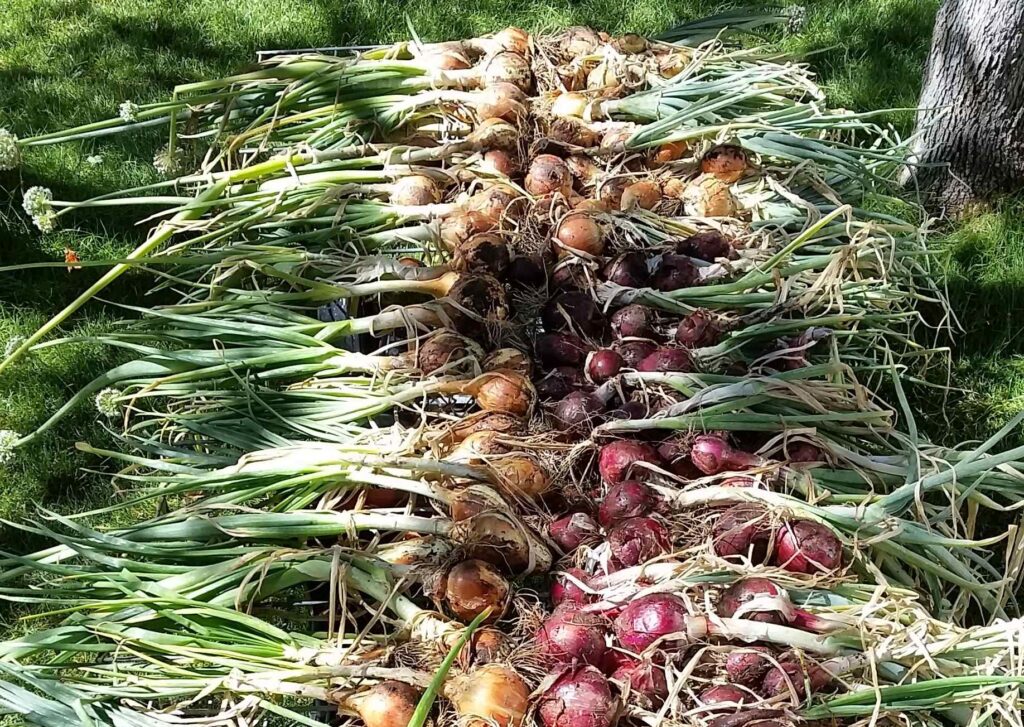
Growing Storage Onions from Seed
Growing storage onions from seed is a frugal and healthy way to add nutritious, flavorful vegetables to the meals you prepare for your family.
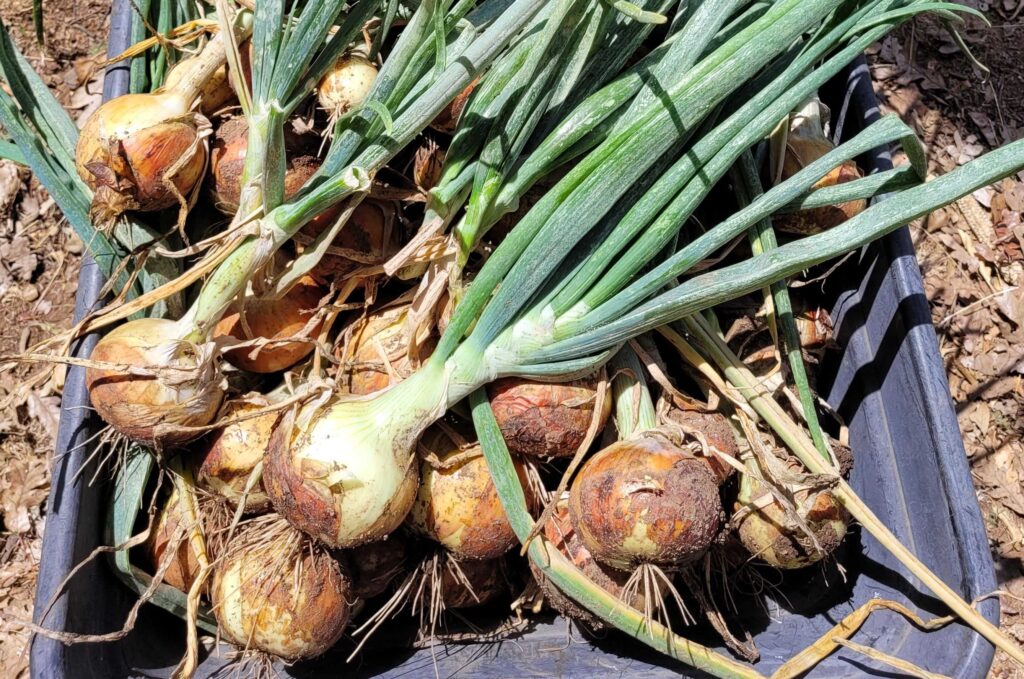
The first seeds that get planted at my house for the new year are storage onions. They may not be the most glamorous vegetable, but they are an absolute staple in any home that cooks from scratch. From omelets to chicken soup, onions are in many of the meals we cook. While there’s an enormous variety of onions out there and I actually grow several different varieties for different purposes, the onions I start in January are my long-term storage onions. These are the ones kept in a cellar, basement, or in my case an insulated pumphouse that we use throughout winter and spring. The variety I grow for this purpose is Patterson which is an exceptionally long storing yellow onion. I usually harvest these onions in August or September and they will last well into April before getting soft.
Why Start Onions From Seed
Why start onions from seed when you can buy sets that are much faster and frankly easier? I have 2 reasons for doing so:
- It’s cheaper to start onions from seed. We’re not called Frugal Family Farms for no reason.
- I can grow the variety that stores the longest. I’ve never found Patterson in sets and that variety stores the longest of any I’ve tested. Having lots of onions go bad in storage is not very frugal. Also, it is incredibly upsetting to spend so much time and effort to grow a quality, healthy vegetable that you absolutely need only to have it rot before you can use it.
In truth I still grow some onions from sets because it is faster and easier. The other varieties that are available in sets I use for fresh eating and canning items such as spaghetti sauce and salsa, so they get used up throughout late summer and fall.
When to Start Seeds
Onions are the first seeds I start because they take a long time to get to transplant size. Most seed packets will direct you to start seeds 10-12 weeks before your first frost, but I find that mine take closer to 14-16 weeks to get to the size of the sets that you’d buy. Truthfully, I find that I need to add a few weeks to the “time to transplant” and “time to maturity” on most plants. Onions are very hardy vegetables and can take a light frost, so mine can go in the garden as soon as I can work the soil. This is usually in early April in my area of far Northeastern California. This means I’m supposed to start onion seeds the first week of January.
Selecting Seeds
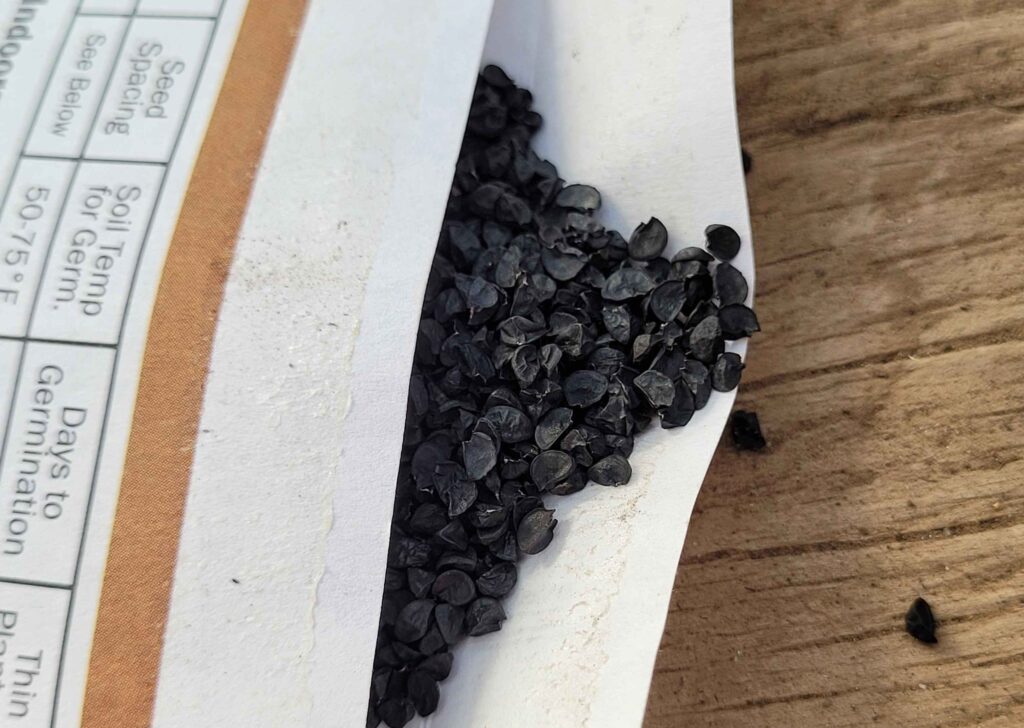
Obviously the first thing you need are onion seeds. What kind to get? This depends on where you live and what kind of onion you want to grow. There are the yellow, white, and red onions we all see in the store. There are also differences in their growing habit, such as when they form a bulb, that is determined by daylight hours. Here’s a quick description of the types based on growing habit.
Long-Day Onions
- Need 14+ hours of daylight to bulb
- Best for northern regions – north of 36° latitude (a line from San Francisco to Washington DC)
- Good storage onions
- Mature about 110 days from transplant
Short-Day Onions
- Need 10+ hours of daylight to bulb
- Best for southern regions – south of 36° latitude
- Can be planted in fall for late spring harvest
Day-Neutral Onions
- Need 12-14 hours of daylight to bulb
- Best for zones 5-6
- Usually sweet varieties
For more information on selecting an onion variety including a map, go to Johnny’s Selected Seeds growing guide for onions. Map & Key Features of Long-Day, Intermediate-Day & Short-Day Onions
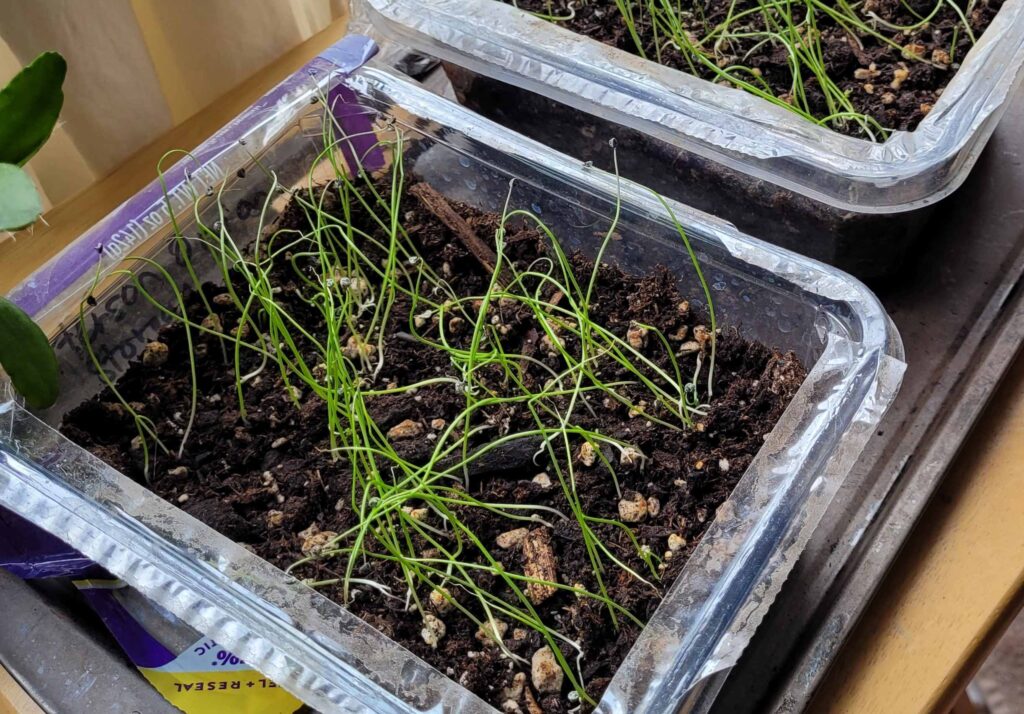
Once you have your seeds, you need a container in which to plant the seeds. I grow mine in a seed starting flat like the ones you’d see at a nursery. You can use any container that works for this purpose like a foil lasagna pan or old Tupperware. I’ve even used the plastic clamshell containers you get salad mix in from the grocery store pictured below. (Sometimes you just need a salad in the winter and it’s tricky to grow greens in 20° weather.)
Planting Seeds
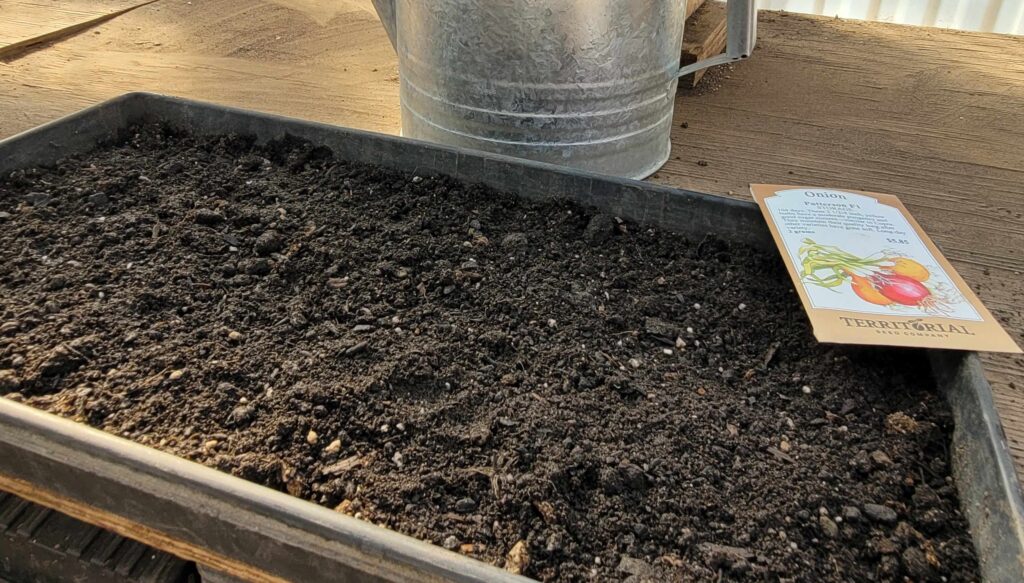
- Fill your container with a good quality potting soil. I use a mix of compost and peatmoss, but any good bagged potting soil should work. I’ve never had luck starting seeds in trays using my regular garden soil because it’s very heavy with very little organic matter to hold water and nutrients for any length of time. I find it’s worth it to spend a little on potting soil vs having seedlings die or never germinate at all and then I have to start the process over. Make sure your soil is damp. You’ll get better germination if you start with damp soil. Not so wet you can squeeze water out, but just damp.
- Sprinkle seeds over the surface of the soil, not so densely that they’re touching each other though. Spacing about a ½” apart will work. This way they have some room to grow as they’ll be in this tray for 14-16 weeks.
- Sprinkle a very thin layer of soil over the seeds. About ¼” is just enough to cover the seeds so they stay moist. Then use a spray bottle to dampen the soil so as to not disturb the seeds or uncover them. You can put some kind of lid on the container if it seems like the soil dries out fast. Even a cover of saran wrap will be enough to keep some moisture in until the seeds sprout.
- Place your tray in a warm location. I will often put mine on a small folding table by the wood stove.
- Once the seeds sprout, they can go under grow lights like any other seedlings. I’ve had mine in a sunny window and while this works, the seedlings are usually very leggy and weak from a lack of the proper amount of light. Continue to water when the soil feels dry to the touch.
- When your seedlings get about 6-8” tall, give them a haircut. Use scissors to trim them down to about 4”. Continue to do this until they’re ready to transplant. This forces them to put energy into their small bulb instead of tall tops.
Transplanting into the Garden
Onions can go in the garden prior to your last frost. I plant mine as soon as I can work the soil, which means as soon as I can get the bed ready without slopping around in the mud.
- Prep your onion bed by loosening or tilling the soil and removing any weeds. I add blood meal or chicken manure to my onion bed because my soil is fairly deficient in nitrogen. I found over many years that while some root crops don’t do well with a lot of nitrogen because that puts more energy to plant than root, onion bulbs will grow much larger if they have a nice tall, robust top. They won’t get a nice top without adequate nitrogen.
- Then poke holes just deep enough so the bulb is just below the soil line. If they’re planted too deep, they will often not bulb as well. Stick a single seedling in the hole and fill the soil gently around the hole. Tip: I use a thin hoe handle to poke all the shallow holes first then I can just drop the seedlings in and lightly hoe or brush soil around each. I like to do this so I spend less time on my hands and knees and because I can get my kids to stick the seedlings in if the holes are already poked.
- I plant my onions in 3 row beds with 8” between rows and plants. This gives enough room for my hula-hoe to fit for weeding without damaging plants, again, so I don’t have to weed on my hands and knees.
- Give your newly planted seedlings a good drink and mulch around them if possible to keep the soil moist and the weeds down.
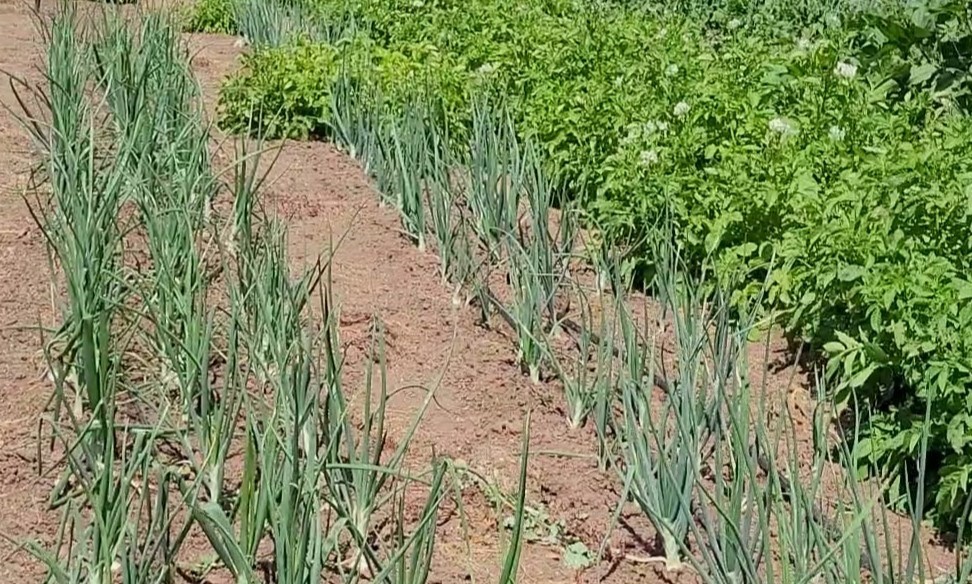
When some of your onion tops start to fall over and turn yellow or brown, which should be in 3-4 months, quit watering them. You can wait until most of them fall over or go bend the remaining tops over to get them ready to harvest and cure.
If your family uses onions regularly, I hope this post encourages you to try growing storage onions from seed. This is a great way to save money compared to buying sets or buying organic onions weekly from the grocery store. You can use this method of starting onions from seed for long term storage onions or fresh eating onions for salads and burgers.